Truck chassis wash and high-pressure side wash
A SUNRISE gantry treats the underbody, the sides and the bodywork in one pass. Each stage has its own nozzles, pressure and program.
- Sheet
- 03 / 04
- Subject
- Chassis and side wash
- Supplier
- europemakine.com
The five SUNRISE stages
-
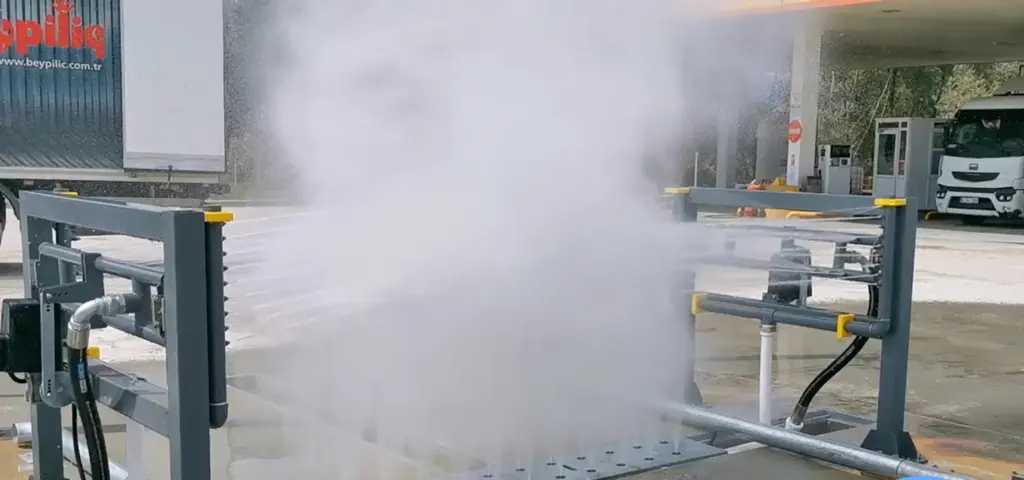
Chassis wash
Nozzles at the line entrance spray the underbody at 7.5 to 10 bar, automatically or by hand. They sit over a reinforced concrete substructure.
-
Robotic side wash
Pulsating jets through two or four turbo jet nozzles work the sides at 70 to 100 bar.
-
Brush wash
Two vertical brushes and one horizontal brush, under pressure control, clean the sides, front, roof and rear.
-
Surface drying
An automatic water sweeping unit uses high-pressure water to clear the surface.
-
Winter drain
Under +4 °C, one button drains the water and chemicals and sets the brushes rotating.
Why the underbody gets its own stage
Dirt under a truck sits out of reach of any brush. The SUNRISE chassis wash puts a row of nozzles at the entrance to the lane, so the underbody is sprayed as the vehicle drives in, before the gantry starts its run.
Pressure on this stage is 7.5 to 10 bar, and the operator can run it automatically or by hand. The nozzles need a reinforced concrete substructure under the lane, which is part of the civil works for a site that orders chassis wash.
Wash pressures
| Chassis wash | 7.5-10 bar |
|---|---|
| Robotic side wash | 70-100 bar |
| Hydrowash option | 20 and 30 bar |
| Feed water pressure | 3.5-4 bar |
| Water requirement, standard build | 70-80 lt/min |
| Water requirement, optional equipment | 250 lt/min |
Side wash for wheel arches and tank sides
The robotic side wash fires pulsating jets at 70 to 100 bar through two or four turbo jet nozzles.
Chemistry runs on its own lines. Rinse water, shampoo and chemicals each have a separate galvanized pipe, with electrically operated dosing pumps and 24 V DC solenoid valves. Shampoo use is 10 to 20 grams per vehicle.
Hydrowash for vehicles that should not be brushed
Hydrowash is the brushless SUNRISE option. High-pressure water robots at 20 and 30 bar replace brush contact. The system senses the size of the vehicle, applies chemicals first to soften the dirt, then reaches indented and protruding surfaces.
Fleets with liveried vehicles use Hydrowash to keep the finish intact. It is modular, so it fits onto the gantry without taking more floor space.
Brush stage and surface drying
After the jets, the gantry runs its brush pass. Two vertical brushes work the sides and one horizontal brush follows the front, roof and rear. Upright trolleys carry the vertical brushes, and pressure (printing) control holds the brush against the body at a set force. Brushes are PE plastic or soft brush.
Surface drying closes the cycle. An automatic water sweeping unit uses high-pressure water to clear the panels before the truck leaves the lane. On the W4000 the full cycle takes 5 to 6 minutes per vehicle.
The PLC runs each stage in turn from the program chosen for the vehicle type, and the operator can take manual control at any point.
Cold-weather operation
The SUNRISE winter drain empties water and chemicals from the system at the push of a button and rotates the brushes so they do not freeze in one position. Cold-weather packages are quoted per site.
Questions and answers
- What does the chassis wash need under the lane?
- A reinforced concrete substructure beneath the entrance nozzles.
- Can the chassis wash run manually?
- Yes. It runs automatically or by hand.
- How many side wash nozzles are fitted?
- Two or four turbo jet nozzles, depending on the build.
Add chassis wash or Hydrowash to a quote
List the stages your fleet needs and Europe Makine will include them in a proforma quotation.
Talk to Europe Makine europemakine.com/contact/